
What daily habit do you do that improves your quality of life?
In Chapter 7 of my book, I explore how important it is to cultivate gratitude as you seek to transform your life and build the life you desire. I even share how having a mindset of gratitude could have lessened the struggles we faced when I was growing up in poverty. Sure, we struggled to make ends meet, but we were so focused on what we lacked that we missed the blessings we had. Blessings that could have contributed to a better quality of life—and overall sense of fulfillment.
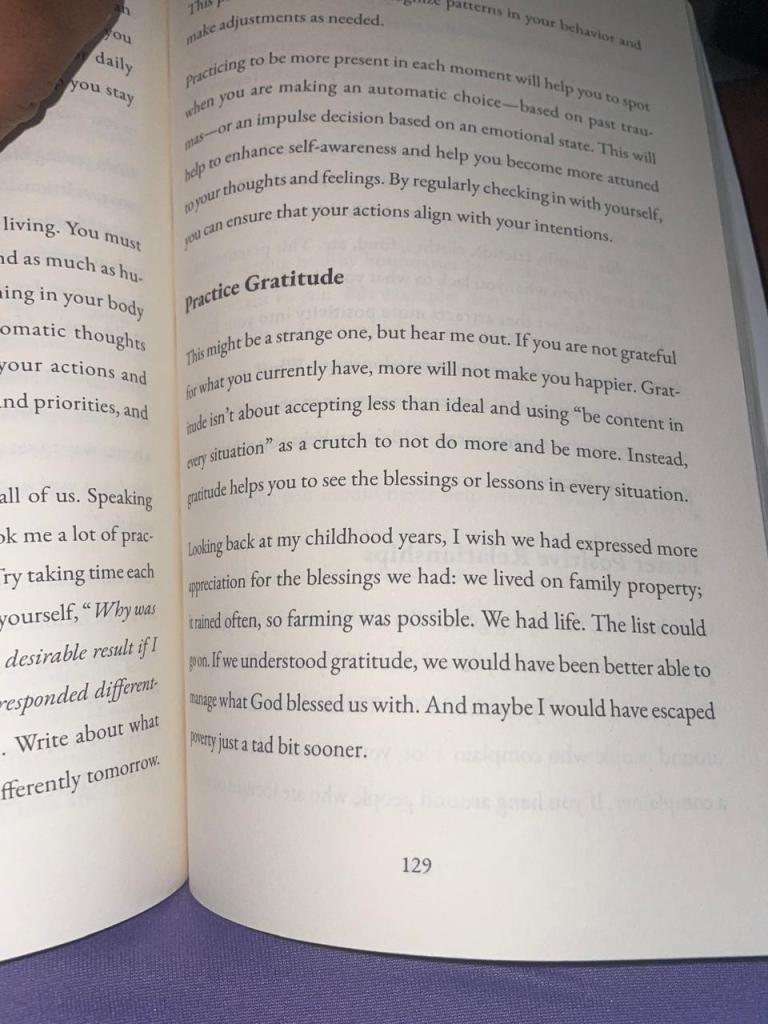
But I must confess, although my current life is quite literally what I dreamed it would be, (happily married, happy kids in good schools, no excessive debt, co-owner of a successful business … I even live in the exact neighborhood I wanted to live in when I was younger), sometimes I regress to old patterns I’ve unlearned. You see, because I have these new big goals and aspirations, I sometimes find myself focusing on what I currently lack.
What this has confirmed for me is that self-improvement never ends and old patterns have a way of repeating themselves when you least expect it. The problem with these old patterns is that they steal your joy and trap you in the past. This diminishes the overall quality of your life, creating a paradox where no matter how good things are on the outside, you still feel miserable and unfulfilled on the inside.
With that said, I’ll use this article to share with you how practicing gratitude can improve the overall quality of your life. I’ll also share 5 ways I’m practicing gratitude that you can too.
How gratitude improves the quality of your life
Have you ever seen those folks (whether it’s in movies, or you’ve read about them in books, or maybe you’ve even seen them in real life), they don’t have much yet they seem so happy and at peace. They are in tune with nature, and the cares of this world seem afar. Why is that? For most of us, the moment we lack something, that thing begins consuming all our attention and focus; until soon, it’s all we are able to see.
The answer is simple: these folks focus their attention on what they have. This allows them to have a more positive outlook on life. Instead of seeing, “I don’t have xyz”, they see “I have abc”. Don’t get confused though, gratitude is not about settling for less than ideal or giving up on your big dreams. Gratitude is about learning to be content in every season of your life, as the scripture says in Philippians 4:11-13.
“…I have learned to be content whatever the circumstances. 12 I know what it is to be in need, and I know what it is to have plenty. I have learned the secret of being content in any and every situation, whether well fed or hungry, whether living in plenty or in want. 13 I can do all this through him who gives me strength.”
Philippians 4:11-13
Gratitude improves the quality of your life by allowing you to be at peace with what you have instead of being consumed by what you lack. It frees up your mind to focus on acquiring what’s truly valuable to you, not just what society says you should have.
5 Benefits of practicing gratitude
- You’ll have a more positive outlook on life
- You’ll be more present in every moment
- You’ll develop the ability to appreciate and enjoy even the simple things
- You’ll experience a deeper connection in your relationships
- You’ll feel calmer and more at peace
How I’m practicing gratitude
1. Taking the time to reflect on what I DO have
It’s so easy to get caught up in what we don’t have—the house, the car, the specific job—that we miss the blessings right in front of us: supportive friends, loving family, a place to call home. I don’t know what it is for you reading this, but I am certain that if you pause and reflect, you have something to be grateful for. For example: you are of sound mind; you have access to electricity; you have internet access; you can read and understand this article. And those are just some random things I was able to pull without knowing who you are.
Back when my now-husband (then-boyfriend) and I moved in together with my first son, life wasn’t perfect. We lived in one bedroom of a shared house, and the person we shared space with was the least hygienic person I had ever met in my life! But we weren’t miserable. We made it work, and we were happy. We were content because we focused on the fact that we were together. We had each other, and we were working towards moving into a better apartment. And though we had our fair share of troubles, we were able to accomplish our goals and still be deeply connected to each other since the cares of life didn’t destroy our family bond as it often does for many.
Fast forward to now, and I’ll be honest—I lost sight of that. For the last nine months, I’ve been more focused on what I don’t have: a house of our own, a healthy relationship with my mother, the security of my old ESL job. And the more I obsessed over what was missing, the heavier the depression settled in. I let gratittude slip away.
So here’s the shift I’m making—and maybe it’s a shift you need too: I’m choosing to focus daily on what I do have. My kids. My husband. My writing. A published book. Our small but growing video game business. Paid bills. Friends who pour into me. The list could go on, but you get the idea. Gratitude is about redirecting the spotlight from the empty spaces to the treasures already in your hands.

Your turn: If you feel like you don’t have much to be grateful for, I challenge you to start small. Write down one thing. And if you honestly can’t think of any, email me and tell me your story—I’ll help you find that one thing you can hold onto. Because there’s always something.
“Every second spent focusing on a problem is a second away from focusing on the solution”
– Tahir Gow
2. Writing a gratitude journal
I have a confession to make. My husband bought me this beautiful notebook for a Valentine’s Day gift some time ago, which I decided to use as a gratitude journal.

But the last few months have been dark for my mental health. I think it’s because I’ve finally processed the emotions I felt after losing my ESL job (read more) and coming to the realization that I’ve been treating the business my husband and I have been blessed with as an optional side gig (not appreciating it or giving it as much of my energy as I should). In a haze of self diagnosed depression, I stopped writing in my gratitude journal.
Recently, in an effort to honor point one—above— I took up my gratitude journal and decided to just read through it (the point of having a gratitude journal is so you can reread your entries when you’re in a rut and feel like there’s nothing good in your life) and oh my gosh! It literally felt like removing scales from my eyes or finally getting new glasses! The clarity I see when I look at my life through zoomed out lenses, (clarity that was blurred by distractions and self comparison) and the overwhelming sense of positivity and appreciation I’ve been feeling is beyond words!
Turns out my life isn’t a dark depressing abyss sucking me into the realm of Hades. *shrugs!
If you have not been keeping a gratitude journal, I encourage you to start today. You can use a regular note book but I recommend using the Daybook app. Here’s why: Best Journaling App: Why I Love the Daybook App.
3. Making an extra effort to care for what I have been blessed with
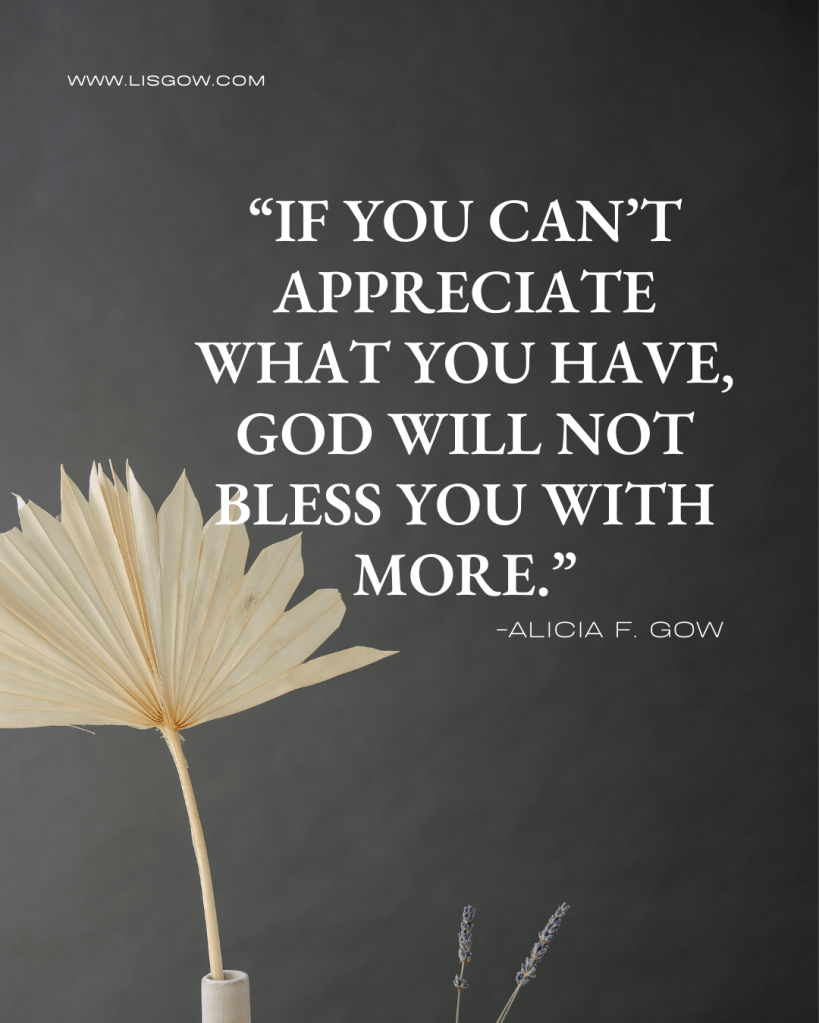
“If you can’t appreciate what you have, God will not bless you with more”
This quote has been playing in my head on repeat for the last few days. This quote speaks so much biblical truth. I think of the parable Jesus told in Matthew 25:14-30. The servants who were eventually blessed with more were the servants who were grateful for what they were initially given and used it well. The ungrateful servant lost everything.
Another scripture that comes to mind is Proverbs 15:31 NIV, which says, “…humility comes before honor”. If I am not humbled by what I have, I will not be honored with more.
Matthew 25:21 says “…well done good and faithful servant! You have been faithful with a few things; I will put you in charge of many things…”
When I reflect on how I’ve been for the past few months, I realize that, among other things, I have let my health go (I gained so much weight); I stopped taking care of my appearance, and I stopped showing up for myself.
How can I expect God to bless me with more if I am not taking care of what he has already blessed me with?
I am now making an active effort to take care of my home and my health, my relationships and myself, and my family business. The result is the sense of joy and peace that has returned to my life, and it’s amazing!
4. Stop comparing myself
“Comparison is the thief of joy”.
And truthfully, this is something that I have wrestled with all my life. I grew up in an environment where I was constantly being compared to others (my siblings, other family members, other children in the neighborhood). This led me to believe I was never good enough. My way of knowing if I was good enough became more about how I measured up to others and less about my actual value or actual results.
Comparison is natural, though. For generations, we have compared ourselves to other humans. It’s how we “check” to see if we are on the “right” path, in the right groups or doing things as we should. It only becomes a problem when it destroys our ability to see our value and thwarts our ability to perceive our blessings and accomplishments.
How to stop comparing yourself to others
- Appreciate the uniqueness of your journey
- Make time to celebrate your progress
- Spend time in God’s word so you can be more in alignment with His will for your life
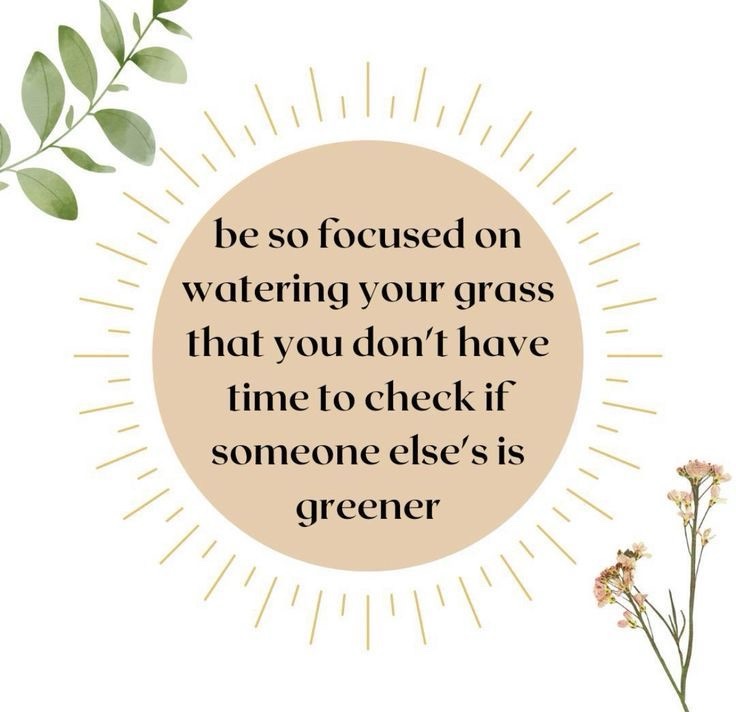
- Keep your focus on your own grass
5. Practicing contentment
The Bible tells us to “be content in every situation,” but I’ve often questioned that translation because I learned from others around me who had clearly given up on their dreams. I thought being content meant settling. To accept defeat. Not wanting more.
But in one of my lowest moments, when the heaviness of the past few months was pressing down on me, I cried out to God. His response was simple: “You are growing, and growing hurts. All you need to do is nourish and support your growth, and wait on the Lord.”
That shifted something in me. And I’d like to offer you the same mindset shift: contentment does not mean settling for less. It means allowing yourself to be at peace regardless of your circumstances. It means finding joy in the season you’re in—even if it’s not the one you would’ve chosen. It means appreciating the journey as much as the destination.
Think about it this way: you can still chase your dreams, change your life, and accomplish your goals while being content. Contentment doesn’t block progress—it makes the journey lighter. You don’t have to be tormented by unmet timelines or unfulfilled milestones, because you can rest in the promise that God is walking with you.
As for me, I’m letting go of the pressure to hit certain milestones by a certain age. Instead, I’m embracing the beauty of the life I’ve built—the life God has blessed me with. And maybe that’s the invitation for you, too: to breathe, to release the timelines, and to find peace where you are while you grow into what’s next.
Journal prompts for reflection
- List 3-5 things you are grateful for today. (They can be small things too.)
- How have you allowed comparison to steal your joy lately?
- In what ways can you better steward your current blessings?
- In what areas of your life do you need to show more gratitude?
Final words…
As always, thank you for reading. I appreciate every single one of you who takes the time out to read this blog, like, comment, or subscribe to this blog. I pray that you are blessed through my writing in one way or another. If you have feedback or specific topics you’d like to see me cover, please let me know either in the comments or by using the contact form on the contact us page. I’d love to hear from you.
God bless you.
-Lis













Leave a reply to Unwanted Life Cancel reply